

Here is what nobody warns you about: the wedding seating chart is not hard because of the seating. It is hard because it lands on you when you are already running on fumes. You have answered 400 texts this month. You have a spreadsheet with a column for “still hasn’t RSVP’d.” You have a venue contract, a caterer who needs final counts, and a mother-in-law with opinions about Table 2. And now you are supposed to open some app, learn it, and arrange 110 people without starting a family feud.
The overwhelm is real, and most seating tools make it worse. They ask you to pick a subscription, watch a tutorial, and start from a blank ballroom template that looks nothing like your venue.
You do not need a more powerful tool. You need one that takes work off your plate. So the question is not “which app has the most features.” It is “which app lets a tired, stretched-thin bride finish the seating chart without it becoming one more thing.” Here is the honest answer, plus the trap that eats the most time and the order I would do it in when you have none.
The short version: An overwhelmed bride needs an app that removes decisions, not one that adds a learning curve. SeatCanvas imports the guest list from the spreadsheet you already keep, lets you draw your real room, and drag names onto tables. It seats 40 guests free with full export, no account required to start. Past 40 it is $19.99 one-time, not a subscription. Import the list, draw the room, assign the tables in one sitting, print the PDF. You can stop and come back; nothing is lost.

Why the seating chart feels heavier than it is
Overwhelm is rarely about one task. It is the pile. The seating chart sits near the bottom of the pile, and it carries three weights that other wedding tasks do not.
It depends on everyone else. You cannot finish it until the RSVPs are in, and the RSVPs come in late, in dribs, from the people you least expected to drag their feet. So it stays open on your mental to-do list for weeks, quietly draining you, even when you are not touching it.
It has social landmines. Picking a caterer is a decision. Seating your divorced aunt across the room from her ex is a decision with feelings attached. The chart is the one planning task where a wrong move shows up as a real scene at the reception, and that pressure makes you avoid it.
It looks like it needs a tool you do not have time to learn. This is the false weight, and it is the one we can actually remove. The seating itself is just decisions. The software around it should be invisible. When an app forces a tutorial and a free trial countdown, it converts a decision problem into a software problem, and a software problem is the last thing an overwhelmed bride needs at 11pm.
Two of those weights are real. The third is fixable. Pick the right app and the chart shrinks back down to what it actually is: a list of people and a room.
The trap that eats the most time
Try SeatCanvas — Free
Build your seating chart visually. Import guests, drag to tables, export a print-ready PDF.
Start Planning Free →Almost every overwhelmed bride does the same thing first, and it is the slowest possible start. She opens a new document and begins typing the seating chart by hand. “Table 1: Mom, Dad, Grandma Rose, Aunt Carol, Uncle Rob…” It feels like progress because words are appearing. It is not progress.
You already have the names. They are in your RSVP spreadsheet, the one you have been maintaining for months. Retyping them into a seating tool is doing the same work twice, and it is the work most likely to make you quit halfway. A 110-person list is an hour of typing before you have made a single actual decision about who sits where.
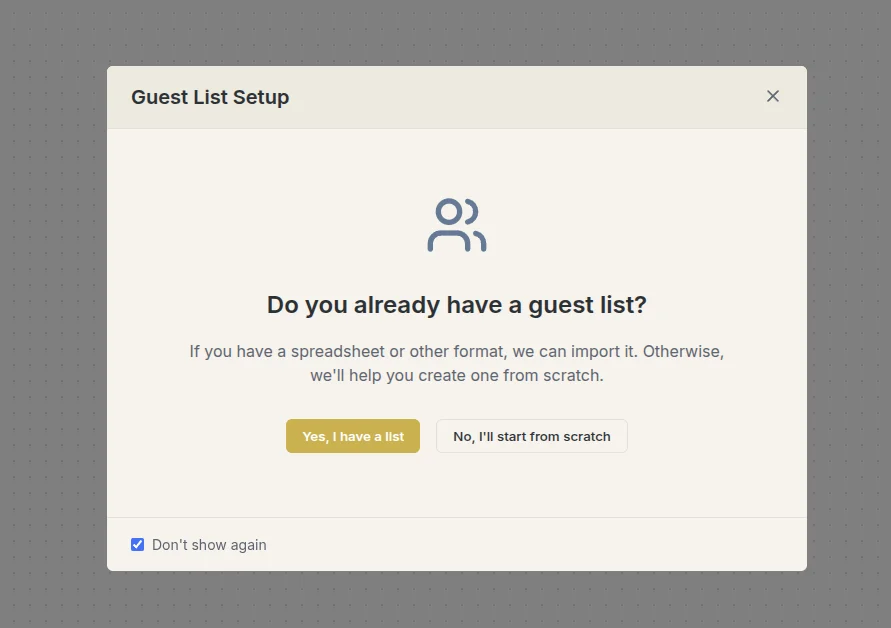
The fix is to never retype. SeatCanvas imports your guest list from a CSV or Excel file, maps your columns — name, side, meal, plus-one — and drops every guest in as a seat you can move. Plus-ones come in as their own seats. The spreadsheet you already built becomes the foundation, not a thing you copy out of by hand. That one choice turns the heaviest hour of the job into about two minutes.
What an overwhelmed bride actually needs from a seating app
Judged on the only test that matters when you are depleted — does this remove work or add it — here is what counts and what is noise.
It starts where you already are
You keep your guest list in a spreadsheet. The app has to meet you there. An app that makes you re-enter everyone is asking for energy you have already spent. Import-first design is the single biggest difference between a tool that helps and a tool that taxes you. Start with the import, and you are halfway done before you have made one hard call.
It is visual, so you can see the mistake before it happens
A text list cannot show you that you sat two exes at the same round table, or that the head table is one seat short, or that Grandma is parked right next to the band. A drag-and-drop canvas shows you the room. You catch the landmine while it is still a dot on a screen, not a problem at the reception. For an overwhelmed bride, seeing beats remembering, because you do not have the spare attention to hold the whole room in your head.
It forgives you for stopping
You will not finish in one sitting, and an app that punishes interruption is the wrong app. SeatCanvas saves your work, so you can close it mid-chart, sleep, deal with the florist, and reopen exactly where you left off. Sign in with Google or Microsoft and it is in the cloud, on whatever device you grab next. Nothing is lost because you got pulled away. That permission to stop is worth more than any feature.
It is free until it genuinely has to cost something
The last thing you need is a paywall the moment the tool gets useful. SeatCanvas seats 40 guests free with every feature on — full canvas, import, export — and you can start without an account. If your list runs bigger, the Event Pass is $19.99 one-time, not a subscription you will forget to cancel on your honeymoon. One small charge, for one event, and you are done.
The honest comparison
Quick reads on what overwhelmed brides reach for, judged on the one question: does it take work off your plate?
SeatCanvas. Import-first, visual, forgiving, free to 40 then $19.99 once. It is built to shrink the job. The honest limit: it plans the seating, not the whole wedding. It will not chase your RSVPs or track your budget. It does the chart, cleanly, and gets out of your way.
A spreadsheet or a blank document. Perfect for the guest list, wrong for the seating. The moment you try to seat people in rows of text, you are describing a room you cannot picture, and every reshuffle means renumbering everything below it. Keep the spreadsheet for names and RSVPs. Import it into something that draws the floor.
Pen and paper. Fine for a 20-guest dinner, brutal past that. Your third reshuffle turns the page into an eraser smudge, and paper cannot import the list you already have. When you are overwhelmed, the constant rewriting is exactly the kind of busywork that breaks you.
The Knot, Zola, and WeddingWire seating tools. Genuinely useful if you already live inside one of those planning suites. But they assume the whole platform, and the seating modules lean on fixed room templates that may not match your venue. If you are overwhelmed, adopting a full ecosystem just to get a chart is more setup, not less. The Knot seating alternative breakdown walks the trade-offs, and the Zola seating chart comparison covers the iOS-only catch.
General design apps. You can draw a chart in a tool you already pay for, but you are placing every table by hand with no guest-list import and no meal-count export. That is a lot of manual work for a one-time job, and manual work is the thing you are trying to escape. The Canva seating chart comparison covers where it falls apart.
The overwhelmed-bride playbook: smallest possible version
You do not have to do this in one go. The point of this order is that each step is short and you can stop after any of them with nothing lost.
Step one, two minutes: import the list. Open the SeatCanvas planner and drop in your RSVP spreadsheet. Map the columns, confirm. Everyone who has replied is now a movable seat. You have already skipped the worst hour. If you stop here tonight, you still made real progress.
Step two, twenty minutes: draw the room once. Drop your tables where they actually go — rounds for most guests, a sweetheart or head table for you two, rectangles where space is tight. Block out the dance floor and bar so you are seating people in the space that is really left. You only ever do this once.
Step three, the real work: assign in passes. Do not try to place all 110 at once. Family first, both sides, near the head table. Then the easy clusters — the college friends, the work people, the neighbors who all know each other. Then, and only then, the hard ones: the plus-one who knows nobody (seat them by your most outgoing friend, never another stranger) and the relatives who need a few tables between them. Seeing it laid out is when the landmines surface, while they are still easy to fix.
Step four, five minutes: export and walk away. PDF with meal counts for the caterer. A big version printed for the entrance, or a CSV you turn into escort cards. Save the project. When your last three RSVPs finally text back, you open it, drag them in, re-export, done.
If your wedding is coming up fast, the last-minute seating guide is built for a tight runway, and if you want the seating logic itself in more depth, how to create a wedding seating chart goes deeper on the assignment strategy. Doing the whole wedding yourself? The DIY bride playbook is the sister guide to this one.

What to skip, because overwhelm means cutting
When you are stretched thin, doing less is the skill. Three seating tasks look thorough and are really just procrastination wearing a productive face.
Drawing the venue to scale. You are making a seating plan, not an architectural survey. Tables roughly where they go, aisles wide enough to walk, the dance floor marked. Nobody measures your chart against the room on the day.
Color-coding everything. Color earns its place when a caterer needs three meal options flagged across 15 tables. With one menu and 60 guests, it is decoration you do not have the energy for. Reach for it only when the size of the event actually demands it.
Waiting for the last RSVP. A handful of people will never reply until you call them the week of. Do not let three stragglers hold the whole chart hostage. Build it now with everyone who has answered, leave a little slack, and drag the late ones in when they surface. That is the entire reason to use an app that makes changes painless.
A wedding seating chart, stripped of the overwhelm, is a list you import once, a room you draw once, and a PDF you can re-export whenever someone changes their mind. Everything past that is the pile talking.
Common questions
What is the best wedding seating chart app for an overwhelmed bride?
SeatCanvas. It is built to take work off your plate, not add a tool you have to learn. You import your guest list from the spreadsheet you already keep, draw your real room, and drag names onto tables. The free tier seats 40 guests with the full canvas, CSV import, and PDF, PNG, and CSV export, and you can start without making an account. Past 40 guests, the Event Pass is $19.99 one-time, with no subscription to remember to cancel.
How do I make a wedding seating chart when I am completely overwhelmed?
Shrink the task to three moves. Import your guest list instead of retyping it. Draw your room once. Then assign tables in one sitting, family first, friends next, the hard cases last. SeatCanvas does the first two in minutes so your energy goes to the only part that needs a human, deciding who sits where. You do not have to finish in one night, and you can drag late RSVPs in whenever they land.
Is there a free wedding seating chart app?
Yes. SeatCanvas seats up to 40 guests free with every feature unlocked, including import and export, and it runs in the browser with nothing to install. That covers a real intimate wedding end to end for zero dollars. If your list runs past 40, the one-time $19.99 Event Pass lifts the cap, so an overwhelmed bride is never forced into a monthly bill.
Do I need to download an app to plan my wedding seating chart?
No. SeatCanvas runs in any browser, so there is nothing to install and it works the same on a laptop or a tablet. Sign in with Google or Microsoft to save to the cloud and pick the chart back up anywhere. An overwhelmed bride planning at her desk one night and on the couch the next does not want a desktop install tied to one machine.
When should I start the seating chart so I do not get overwhelmed?
Build the room and import your list as soon as most RSVPs are in, usually three to four weeks out. Doing the easy setup early means the only thing left near the wedding is dragging in stragglers and fixing last-minute moves. The overwhelm usually comes from saving the whole job for the final week. Splitting it into a setup pass and a cleanup pass keeps it small.
You are carrying enough. The seating chart should be the task that finally feels easy, not the one that breaks you. The trick is an app that starts from the list you already have, shows you the room so you can see the problems coming, and lets you put it down and pick it back up without losing a thing.
Open SeatCanvas and start by importing your guest list. The first 40 seats are free, no account needed. If your wedding runs bigger, the Event Pass is $19.99 one-time — once, for the one event you are building it for. That is the deal an overwhelmed bride deserves.
✦ Google Preferred Source
Want to see more SeatCanvas stories on Google?
You can ask Google to show SeatCanvas more often in your own Top Stories and supported Google experiences. This personalizes your account; it does not raise SeatCanvas for everyone.
Google's control loads only after you choose Continue with Google.