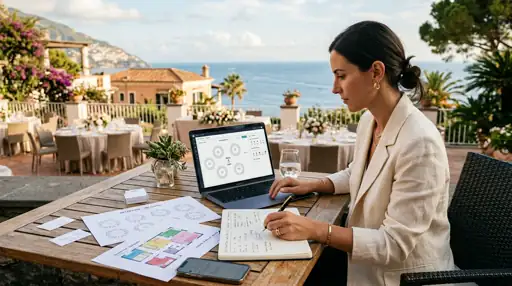
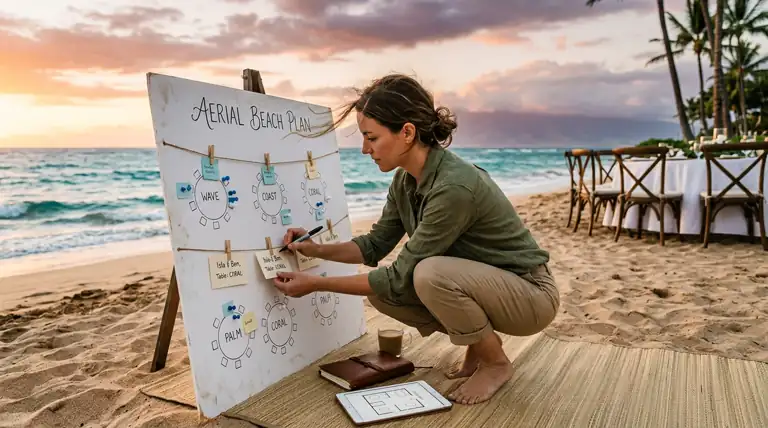
Most “best seating chart maker” lists picture a ballroom. Four walls, a floor plan the venue already drew, numbered tables, a coordinator with a diagram. A beach wedding deletes all of it. You get a strip of sand, a tide that moves the usable width by the hour, wind off the water, and a sunset that decides when dinner starts.
The chart is carrying more weight here. Indoors, the room tells the tables where to go. On a beach, the chart is the room. It is the only place the layout exists until the rental crew shows up with flooring, poles, and a truck full of rounds. And a beach has a problem a lawn does not even have: the floor is sand, and sand swallows table legs, chair legs, and every heel in the wedding party.
Here is the honest version for couples and planners doing a beach wedding: what the shoreline actually demands from a seating tool, the view problem nobody mentions until the day, and how to keep the whole thing off the sand and out of the surf.
The short version: A beach chart does three jobs a ballroom chart never does — keep tables on rented flooring instead of soft sand, ration the water view across a room that all wants it, and survive wind off the ocean. You want a blank canvas you can shape to the real shoreline, not a stock template. SeatCanvas seats 40 free with full canvas, import, and export; past 40 it is $19.99 one-time, which fits the travel guest lists beach weddings tend to pull. Build the layout against the flooring footprint, fan the tables so most get a partial view, export a PDF for the rental crew, and keep a copy on your phone for the moment a card goes into the surf.
Why a beach chart is its own problem
A ballroom is a solved space. The venue hands you a CAD diagram, the tables are numbered, the dance floor sits where it always has. You drop names into a grid someone else drew. Even a tented lawn, with its poles and rain plan, is at least flat and stable underfoot.
A beach hands you none of that. The constraints are loud, and not one of them is drawn for you:
- The floor is sand. Tables and chairs sink. Heels sink. Most beach receptions rent flooring or a deck for the seated dinner, which means the usable surface is a rectangle you pay for, not the whole beach. Your tables live on that rectangle or they tip.
- The tide owns the width. Low tide gives you forty feet of firm sand. High tide gives you fifteen and a wet ceremony line. The beach you walk during the site visit is not the beach you get at 6 PM.
- Everyone wants the water. A ballroom view is the same from every seat. On a beach, one direction is the ocean and the other is the parking lot. You physically cannot face every table at the water, so the view becomes a thing you ration.
- Wind off the water, and a sunset clock. Sea breeze is steadier and stronger than a lawn gust. Escort cards do not stand a chance. And the sunset sets the dinner time, the glare, and which side of the tables eats with the sun in their eyes.
None of that is a reason to skip a beach wedding. It is the reason the chart has to be sharper than a ballroom would ever need. The tool you pick should make the shoreline problems easy to solve on a screen, weeks early, instead of pretending the beach is just a room with nicer light.
What a beach wedding needs from a seating tool
Try SeatCanvas — Free
Build your seating chart visually. Import guests, drag to tables, export a print-ready PDF.
Start Planning Free →Feature-count rankings are useless here. The shoreline rewards a short list of specific capabilities and ignores most of the rest.
A blank canvas, not a stock room
This is the one that matters most. Template-driven seating tools drop you into a pre-drawn rectangle with the dance floor already placed. Wrong starting point for a beach. Your space is whatever the flooring rental and the tide line allow, and it is shaped like a strip, not a ballroom.
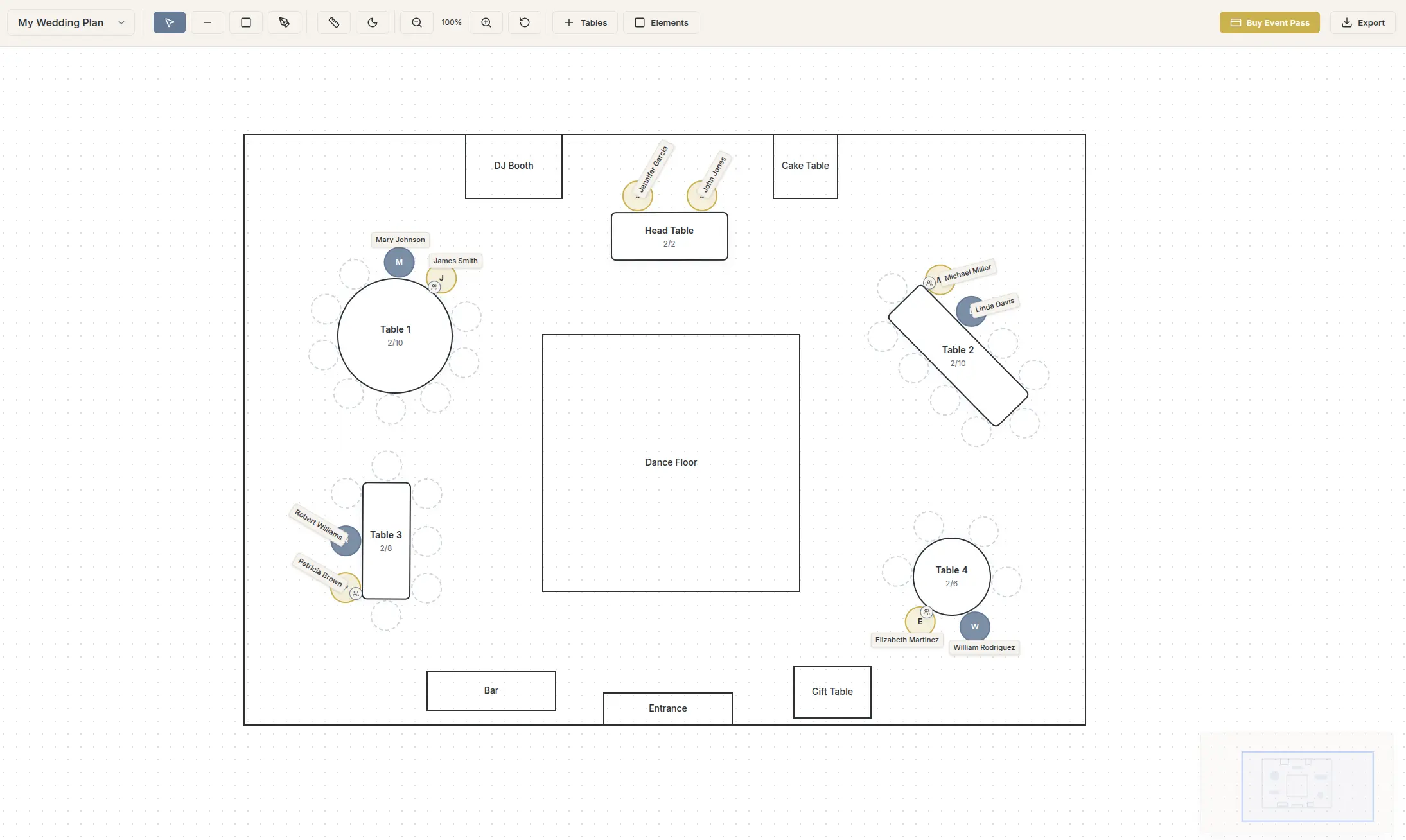
You want a tool that opens empty and lets you build the footprint that matches the sand. SeatCanvas opens blank. You draw the flooring outline, mark the ceremony arch and the shoreline edge, then drop round and rectangular tables onto the firm surface where the real ones will sit — see our 130-guest beach wedding seating chart example for a complete floor plan layout. A soft patch the crew will not floor over is a real obstacle. Block it out and keep tables off it, the same way the rental company will.
A way to ration the view
The water view is the whole reason you booked a beach. It is also the one thing you cannot give everyone. A grid of tables all facing the ocean does not fit on a strip of flooring, and the back rows would stare at the backs of the front rows.
The fix is a ranking, and the chart is where you make it. Put the sweetheart or head table with the water behind it, so the couple gets the ceremony backdrop in every dinner photo. Parents and grandparents take the next-best sightlines. Then fan the rest of the tables in a shallow arc instead of a hard grid, so most guests catch a partial view and nobody eats facing a fence. On a blank canvas you can drag tables into that fan and see the sightlines before the rental crew sets a single round. The argument over who faces the water happens on a screen in week three, not on the sand at golden hour.
Import that survives a travel guest list
Beach weddings pull people from everywhere. A destination crowd means a long, messy spreadsheet — flight info, hotel blocks, plus-ones who RSVP’d late from three time zones over. Retyping a 130-row sheet by hand is a bad use of an evening you could spend on the actual seating.
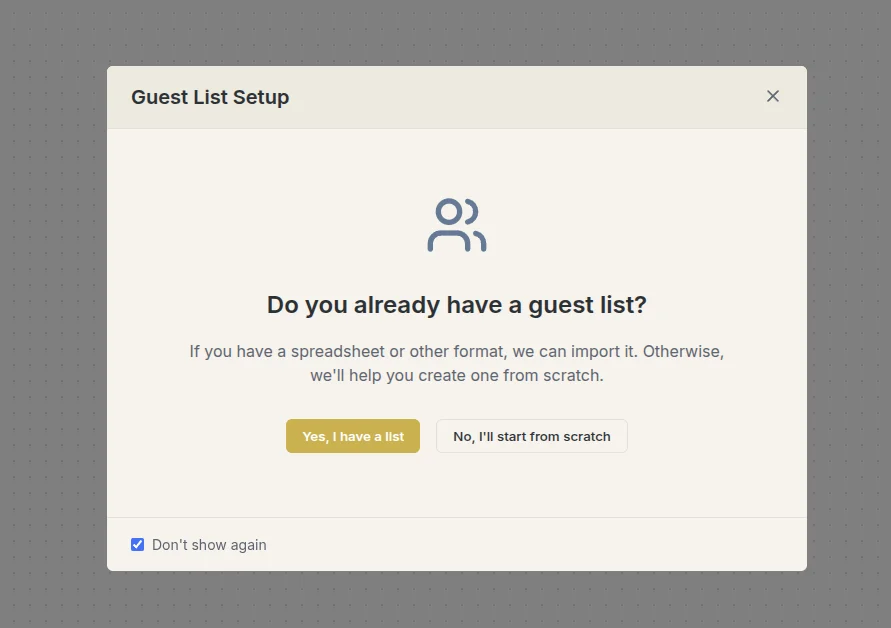
If your RSVPs live in a Google Sheet or an Excel file, the tool should take the sheet. SeatCanvas has a CSV and Excel guest list import that maps your columns and brings plus-ones in as their own seats. A 130-row sheet lands in a couple of minutes, not an afternoon. If your beach wedding is also a destination wedding, the destination table planner guide covers the travel-list mechanics in more depth.
A real export for the rental and flooring crew
Indoors, the venue owns the floor plan. On a beach, you do. The rental company laying the flooring wants a layout to match its panel count and the table spacing. The caterer wants meal counts by table. The day-of coordinator wants a diagram to hold while pointing 120 guests across the sand toward chairs.
That is three handoffs, and they all run on a clean export. SeatCanvas does high-quality PDF and PNG export plus a CSV of the guest-to-table mapping. One file to the flooring crew, one to the caterer, one printed and framed for the welcome table. No retyping between them, and no version drift when the last RSVPs shift a table.
The shortlist for beach weddings
Honest reads on the names that come up, judged against the shoreline problems above.
SeatCanvas
Best for: any beach wedding where the layout has to be invented from the flooring footprint up, and the view has to be rationed before the day.
Free up to 40 seated guests with the full canvas, import, and export. $19.99 one-time for unlimited, which covers the 80-to-150-guest destination crowds the beach format tends to produce. No subscription, no watermark on the PDF the rental crew works from. Round, rectangular, and custom table shapes, so a long banquet table parallel to the shoreline is as easy as a room of rounds.
The honest limitation: SeatCanvas draws the seating layout, not the tide chart or the flooring engineering. It will not tell you the high-water line at 6 PM or how many panels of decking the rental company needs. That is the venue’s and the rental crew’s job. What SeatCanvas gives you is the table plan those vendors build against — the artifact a beach wedding is missing until you make it.
Pen and paper
Best for: a 20-guest barefoot dinner at one long table above the tide line.
Free and fast for a tiny shoreline party. The break point is wind and revisions. A paper chart on an open beach is a paper chart in the surf by cocktail hour, and the third reshuffle when the flooring footprint changes turns the draft into an eraser smudge. Past a couple of tables on sand, paper loses.
The Knot, Zola, WeddingWire seating tools
Best for: couples already living inside one of these platforms with months of runway.
The seating modules are real, but they assume the indoor template world — a room you fill, not a shoreline you shape. For a flooring rectangle on sand with a view to ration and a tide line to respect, a fixed-room editor fights you. If you are not already inside one of these suites, do not adopt a whole planning ecosystem just for the chart. The WeddingWire seating chart breakdown shows why standalone beats suite for a chart-only job.
Subscription seating sites
Best for: nothing about a one-day beach event.
A monthly bill for a chart you build once is the wrong shape. The wedding is one day. The chart is one project. Pay once or pay nothing — a recurring charge that lands the month after the thank-you cards does not fit an event with a hard end date.
The beach-wedding playbook
This assumes a guest list in a sheet and a known beach with a flooring rental on order. Work it in one focused sitting.
Get the flooring footprint and the tide times first. Before you place a table, get the rental company’s flooring dimensions and the tide schedule for your ceremony and dinner hours. A 30-by-40 deck at low tide and the same deck with the water fifteen feet closer are different problems. Your chart matches the surface they are actually laying.
Open the canvas and draw the footprint. Go to the SeatCanvas planner. Draw the flooring outline to the rental dimensions. Mark the shoreline edge, the ceremony arch, the dance floor, the bar, and the band or DJ. Those are fixed. Everything else fits in the space left over. Heat moves the bar numbers as well, so I run beach receptions through the wedding alcohol calculator before placing the drinks order.
Import the guest list. Drop your CSV or XLSX, map the columns, confirm. Plus-ones come through as their own seats. A travel guest list is exactly the case where import earns its keep — a 130-row sheet lands in minutes instead of an hour of typing.
Rank the view, then place tables. Sweetheart or head table with the water behind it. Parents and grandparents on the next-best sightlines, and on the firmest footing, off any soft patch and out of the dance-floor traffic. Fan the rest in an arc so most tables get partial water and nobody faces the lot. Leave 4-to-5-foot lanes for caterers — flooring panels are less forgiving than a ballroom floor when a tray-carrier has to squeeze past.
Assign guests. Family first, both sides, closest tables. Then friend clusters. Then plus-ones who know no one — seat them next to a talker, not next to each other. Beach weddings usually run a long cocktail hour on the sand, so the dinner assignment matters more for the seated stretch than for mingling.
Export everything. PDF to the flooring and rental crew so the setup matches the plan. CSV to the caterer for meal counts. A printed, framed copy for the welcome table. Save the project so you can reshuffle when the last travel RSVPs land.
A general step-by-step lives in how to create a wedding seating chart, and if your beach wedding shares the open-air challenges of a tent on grass, the outdoor wedding seating guide covers the rain-plan and tent mechanics that overlap.
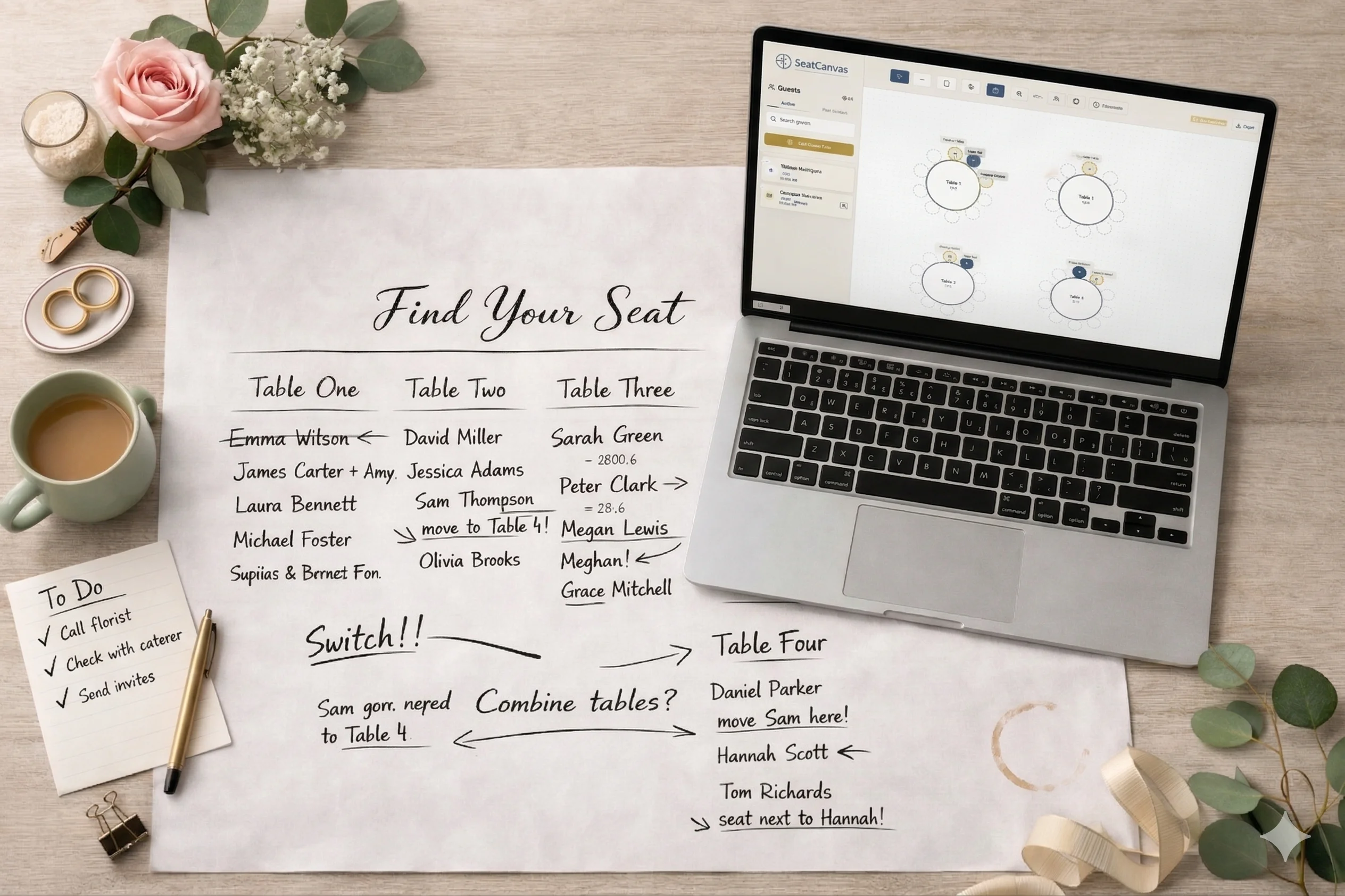
The sand and wind problems nobody warns you about
Two small disasters wait at every beach wedding, and both are solvable on the chart.
Sand eats furniture. A round table on bare sand tilts the moment someone leans on it, and grandma’s chair sinks an inch with every shift. The whole seated dinner belongs on rented flooring or a deck for this reason. Draw the flooring footprint first and treat the open sand as off-limits for tables. The cocktail hour can spill onto the beach; the dinner cannot.
Wind takes the paper. Sea breeze is steadier than a lawn gust, and by cocktail hour your escort cards are halfway to the next beach. The fix is part physical, part digital. Physically: print one large master chart, frame it behind glass, and weight the easel so it does not become a sail. Skip free-standing escort cards unless they sit in something heavy — a tray of sand, a slotted board, a wall of greenery. Digitally: keep the chart on your phone. When a guest swears they are at table 6 and the card is gone, the coordinator pulls up SeatCanvas and answers in seconds. A beach has more ways to lose the paper than a ballroom does, so the live copy matters more.
The chart is a living thing until the toasts start. On a beach, it is a living thing the wind and the tide are both working against. Plan for that and the day stays calm.
What to skip for a beach wedding
Three temptations, all dressed up as thoroughness.
Modeling the whole coastline to scale. You are drawing a seating plan, not a survey. Mark the flooring, the arch, the dance floor, and the shoreline edge. The exact curve of the beach is the venue’s problem, not the chart’s. An hour spent drawing a precise dune is an hour not spent on the actual assignments.
A separate chart for every tide. You need one plan built against the usable footprint at dinner time. You do not need a low-tide layout, a high-tide layout, and a king-tide contingency. Confirm the flooring sits above the dinner-hour water line and build one chart on it.
Color-coding for its own sake. Useful when the caterer needs to flag three meal options across 15 tables. Skip it for a 50-guest barefoot dinner where one phone call covers the dietary notes. Match the effort to the size of the event.
The beach seating chart is one plan on the flooring footprint, a view ranking, and a framed copy that will not blow away. Everything past that is theater.
Common questions
What is the best seating chart maker for a beach wedding?
SeatCanvas. It opens to a blank canvas instead of a fixed ballroom template, so you can map your real shoreline footprint, the rented flooring, and which tables face the water. The free tier seats 40 guests with full canvas, CSV import, and PDF and PNG export. Past 40, the Event Pass is $19.99 one-time, which fits beach weddings since they often pull a travel guest list.
How do you make a seating chart for a wedding on sand?
Start from the usable beach width at your ceremony time, not the whole shoreline. Mark the rented flooring or deck, the dance floor, the bar, and the path elderly guests will walk, then place tables on the firm surface. Sand swallows table legs and heels, so the chart has to keep tables on the flooring the rental crew lays down, not on open sand.
How do you decide who faces the water at a beach wedding?
You cannot seat every table facing the ocean, so the view is a ranking decision. Put the couple’s sweetheart or head table with the water at its back for photos, parents and grandparents on the next-best sightlines, then fan the rest in an arc rather than a grid so most tables get a partial view. Map it on the chart before the day so the argument happens on a screen, not on the sand.
Does wind ruin a beach wedding seating chart?
Loose escort cards on open sand are gone by cocktail hour. Print one large master chart, frame it behind glass, and weight the easel. Skip free-standing cards unless they sit in something heavy. The real backup is digital — keep the chart on your phone so the coordinator can answer a seating question in seconds when the wind has already taken the paper.
How big should the rented flooring be for a beach reception?
Size it for tables plus 4-to-5-foot lanes between them and a dance floor, then confirm it sits above the dinner-hour tide line. Build the table plan first in SeatCanvas, count the footprint it needs, and hand that number to the rental company so the decking matches the chart instead of the chart squeezing onto whatever shows up.
A beach wedding is the prettiest seating job and one of the trickiest. The floor is sand, the view runs out before the tables do, and the chart is the only version of the room that exists until the flooring goes down. Pick a tool that lets you draw the real footprint, rank the water view, and hand a clean PDF to the rental crew — and the shoreline becomes a calm event instead of a sandy scramble.
If you want to see how the layout comes together, open SeatCanvas and draw your flooring. The first 40 seats are free. If your beach wedding runs bigger — and a travel guest list usually does — the Event Pass is $19.99 one-time, and the whole plan lives in one place you can pull up on the sand.
✦ Google Preferred Source
Want to see more SeatCanvas stories on Google?
You can ask Google to show SeatCanvas more often in your own Top Stories and supported Google experiences. This personalizes your account; it does not raise SeatCanvas for everyone.
Google's control loads only after you choose Continue with Google.